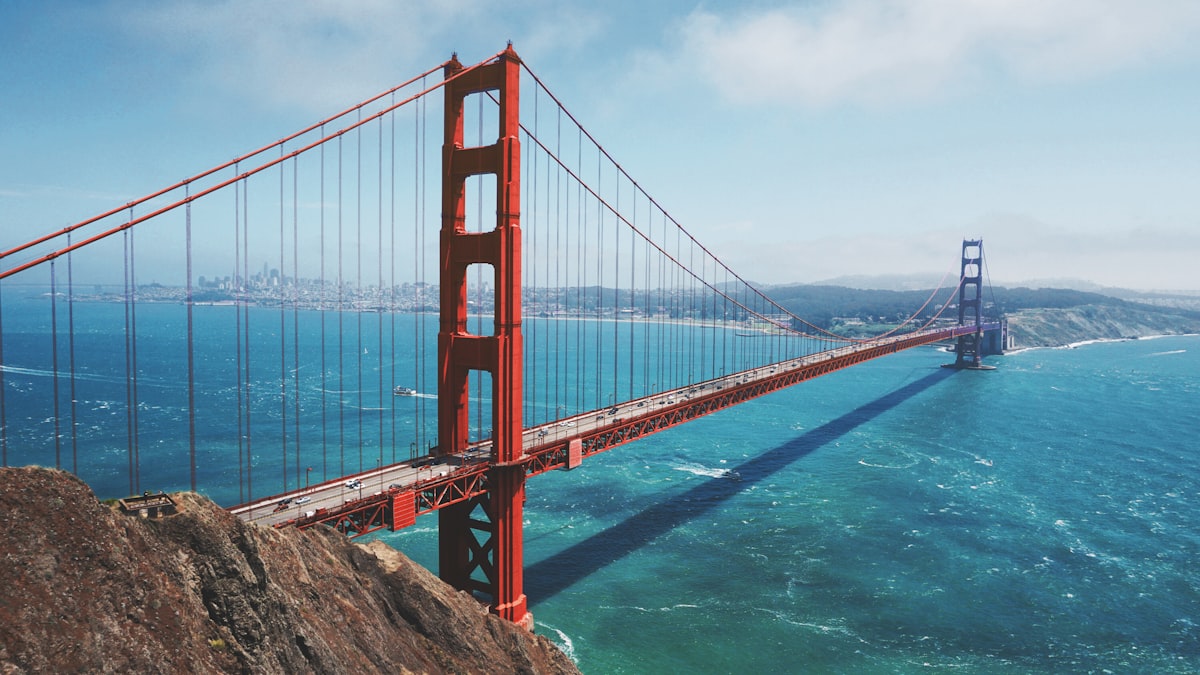
Golden Gate Bridge
Toll Rates 2026
Tolls are collected southbound only (into San Francisco). Northbound is free. No cash accepted - all tolls are electronic.
How much is the Golden Gate Bridge toll in 2026?
A standard car pays $10.25 with FasTrak, $10.50 by pay-by-plate (license-plate billing), or $11.25 on a one-time invoice. Carpools of three or more with a FasTrak Flex tag pay $8.25. The toll is charged southbound only, from Marin into San Francisco; northbound, walking, and biking are free. These are the FY2026-27 rates, effective July 1, 2026.
Does the Golden Gate Bridge have a toll?
Yes - but only in one direction. Every car pays a toll heading southbound, from Marin County into San Francisco: $10.25 with FasTrak or $10.50 by pay-by-plate. The northbound trip out of San Francisco is free, and walking or biking across is free in both directions. There are no cash booths; the bridge has been fully electronic since 2013.
2026 Toll Rate Table
Southbound tolls only. Northbound crossings are always free. Rates effective since 1 July 2026.
| Payment Method | Toll | Notes |
|---|---|---|
| FasTrak (standard) | $10.25 | Transponder required |
| Pay-by-Plate | $10.50 | License plate billed by mail |
| Carpool FasTrak (3+ occupants) | $8.25 | FasTrak Flex tag, 3+ people |
| Motorcycles (FasTrak) | $10.25 | Same as standard car rate |
| Motorcycles (Pay-by-Plate) | $10.50 | Same as standard car rate |
| Multi-axle (3+ axles, FasTrak) | $30.75+ | $10.25 per axle |
Source: Golden Gate Bridge Highway and Transportation District. Last verified September 2026.
Next toll increase: July 1, 2027
Rates shown are the FY2026-27 schedule, in effect since July 1, 2026. Under the five-year schedule the GGBHTD board adopted in March 2024, the next step lands on 2027-07-01: a standard car will pay $10.75 FasTrak, $11.00 license plate, $11.75 invoice, and $8.75 carpool. The schedule then finishes with a fifth step in July 2028.
Annual Cost Calculator
Tolls are collected southbound only. Estimate your weekly, monthly, and annual crossing costs.
Northbound crossings are free
Adjust for holidays/vacation
Annual cost comparison for 10 crossings/week, 50 weeks/year
Driving across multiple Bay Area bridges?
The Golden Gate is one of eight toll bridges that ring the Bay. Tick the ones you cross — we'll show your full trip cost across FasTrak, pay-by-plate, and invoice, plus the carpool break-even.
Tolls collected one way only on every Bay Area bridge; the reverse direction is free. State-bridge rates are the January 2026 BATA schedule ($8.50 for every payment method until prices split in January 2027). On the seven state-owned bridges the carpool discount requires 3 or more occupants and a FasTrak Flex transponder set to position 3 (a standard FasTrak tag qualifies at the Bay Bridge), weekdays 5-10 AM and 3-7 PM only. On the Golden Gate Bridge the $8.25 carpool rate needs 3+ occupants in toll lane #2 during weekday commute hours (5-9 AM and 4-6 PM); any FasTrak tag works there and no tag position is set.
How to Pay Your Toll
Three ways to pay. FasTrak is cheapest, pay-by-plate is automatic, and rental cars need special attention.
Key Facts
How Golden Gate Bridge Tolls Work
The Golden Gate Bridge toll is collected southbound only, when driving from Marin County into San Francisco. Northbound crossings from San Francisco into Marin, Sonoma, or Napa counties are always free. This one-way system has been in place since 1968, when the bridge authority eliminated the northbound toll to speed up the plaza.
The bridge went fully electronic in March 2013. There are no staffed toll booths and no cash is accepted. You pay via one of three methods: FasTrak transponder ($10.25), license-plate billing ($10.50), or the FasTrak Flex carpool rate ($8.25) with three or more occupants. The system reads your transponder or photographs your plate as you cross at highway speed.
The Golden Gate Bridge uses the California FasTrak system, not the East Coast E-ZPass. If you have an E-ZPass from another region, it will not be detected here and you will be billed at the higher pay-by-plate rate. Learn more about FasTrak.
FasTrak vs Pay-by-Plate: Which Should You Use?
FasTrak is the cheapest way to cross the Golden Gate Bridge. A standard passenger car with FasTrak pays $10.25 per crossing. Without FasTrak, the cheapest fallback is a License Plate Account at $10.50 (a $0.25 per-crossing premium, about $125 per year for a 10-crossings-per-week commuter). The one-time Invoice rate for casual visitors is $11.25, a $1.00 premium per crossing.
For occasional crossings, tourists, visitors, road trips, pay-by-plate is simpler. You don't need to set up an account. Just drive through; the cameras photograph your plate and a bill arrives within 21 days. Pay within 48 hours at bayareafastrak.org/paytoll and there's no penalty.
For anyone crossing 50+ times per year, FasTrak is worth the setup. Open a Bay Area FasTrak account free at 511.org. The transponder is free for FasTrak Flex (which also enables the carpool rate) or $25 for standard FasTrak, with the setup fee credited to your first crossings. See FasTrak sign-up steps or pay-by-plate details.
The $8.25 Carpool Discount
The Golden Gate Bridge carpool toll is $8.25 per crossing, $2.00 (about 20%) off the standard $10.25 FasTrak rate. To qualify you need three or more occupants, a FasTrak account in good standing, and you must cross in toll lane #2 on the west (right) side of the plaza during the carpool hours. Any FasTrak tag works on the Golden Gate, standard or Flex, and there is no tag position to switch (unlike the seven state-owned bridges, which require a FasTrak Flex tag set to position 3).
The Golden Gate carpool rate applies only during weekday commute hours: 5-9 AM and 4-6 PM, Monday through Friday, and not on seven holidays (New Year's Day, Presidents' Day, Memorial Day, Independence Day, Labor Day, Thanksgiving, and Christmas). Outside those windows a 3-person vehicle pays the standard $10.25. Occupancy is enforced in the carpool lane, and claiming the discount without the required occupants can draw a violation penalty. Signing up for a Bay Area FasTrak account is free at 511.org. Full carpool program details.
For Tourists and Rental Cars
Most Golden Gate Bridge crossings by visitors happen in rental cars. Most rental companies automatically charge your credit card for the toll plus a convenience fee, typically $4.95 to $5.95 per day, capped around $34.65 per rental. On a week-long trip with one bridge crossing, you could pay $35 in fees for a $10.50 toll.
There are two ways to avoid the fee:
- Pay within 48 hours at bayareafastrak.org/paytoll or by calling (877) BAY-TOLL. Most rental companies won't charge you if the toll is already paid.
- Opt out at the counter. Hertz, Enterprise, Avis, and Budget all offer the option to decline their automatic toll program before you drive.
For a longer Bay Area trip with multiple bridge crossings (Bay Bridge, San Mateo, Dumbarton), the daily fee can be worth it. Otherwise, pay yourself.
Not driving? Walking or cycling across the Golden Gate Bridge is completely free. See the walking & biking guide for hours, routes, and tips. Full rental-car guide.
Frequently Asked Questions
Does the Golden Gate Bridge have a toll?
What is the current Golden Gate Bridge toll in 2026?
How much does it cost to cross the Golden Gate Bridge?
Is the Golden Gate Bridge toll only one way?
Can I pay cash at the Golden Gate Bridge toll plaza?
Does E-ZPass work on the Golden Gate Bridge?
How do I pay the Golden Gate Bridge toll with a rental car?
What happens if I don't pay the Golden Gate Bridge toll?
Is it free to walk or bike across the Golden Gate Bridge?
Bay Area Bridge Toll Guides
Full toll, carpool-hours and payment guide for each state-owned bridge. All $8.50 in 2026.
San Mateo Bridge toll
$8.50SR-92 - Hayward to Peninsula
Antioch Bridge toll
$8.50SR-160 - Antioch to Sherman Island
Bay Bridge toll
$8.50I-80 - SF to Oakland
Dumbarton Bridge toll
$8.50SR-84 - Fremont to Menlo Park
Richmond-San Rafael toll
$8.50I-580 - Richmond to San Rafael
Carquinez Bridge toll
$8.50I-80 - Crockett to Vallejo
Benicia-Martinez toll
$8.50I-680 - Benicia to Martinez
Or see the full comparison of all 8 Bay Area bridges.
Following a route number rather than a bridge name? Look the toll up by highway: 80, 84, 92, 101, 160, 580 and 680.